Saturday, October 1, 2011

A dirty word around here

I don't make a habit of yelling obscenities at my father down the phone, but when the conversation throws up (and I use the expression advisedly) the name of a certain tabloid hack, I cannot contain myself. After my father has demonstrated that he's fallen hook, line and sinker for the 'free speech' canard, and that he's one of the readers whom said hack has squarely in his sights when he (the hack, not my father) sets out to bring out the worst in human nature, in all its greed, spite, envy, small-mindedness and mean-spiritedness, and my dad is not habitually any of those things as a rule, I say to him, Father, I say, let me ask you something.

Suppose, just suppose, that instead of being an evenly distributed mixture of both your parents, you had turned out the absolute dead spit of your father, with no visible sign that you were your Scottish mother's son.

Let us then suppose that for some reason you had been taken away from your father, or he from you, in early infancy, and, despite your lack of any family resemblance to her, you had nonetheless been brought up exclusively by your mother, in Edinburgh or Stirling or Glasgow, being taught her values and supported by her family.

Let us further suppose that then, one day, a grant or scholarship or job became available that was earmarked exclusively for persons identifying as Scots. And let us suppose that you applied for, and were successful in obtaining, said grant or scholarship or job.

What would you say, and how would you feel, if some non-Scottish tabloid hack then wrote a breathtakingly unpleasant, crudely sarcastic, factually inaccurate and demonstrably defamatory article identifying you by name and sneering at you for being a false pretender to eligibility for this prize, arguing that you do not look Scottish (for he just knows what a Scot is supposed to look like) and therefore cannot possibly be your mother's son, and therefore -- 'therefore' -- not a Scot?

Frankly I thought this was a pretty classy argument, and I was hoping it would stop my father in his tracks. Unfortunately, for him as for so many other people and to quote the great Fran Leibowitz, the opposite of 'talking' is not 'listening'. The opposite of 'talking' is 'waiting'.

AFL Grand Final: picture, thousand words, etc


Friday, September 30, 2011

Thinking about Alexander McCall Smith


The other day I heard someone in an extremely influential literary job describe the writing of Alexander McCall Smith, in passing and almost subvocally, as 'Shit.'

Fascinating, I thought, that someone for whom 'shit' is an acceptable judgement of anything should be so sure of her own literary judgement and so dismissive of someone almost preternaturally articulate, someone who has taken to Twitter like a duck to the proverbial and has elevated the Tweet to a new poetic form with an emphasis on the the way that meaning can be clarified and nuance introduced by means of punctuation. Not just fascinating, but remarkable, that such a judgement should have been formed and expressed. How nice to be so sure of one's place in the world.

Of course, I'm partisan: I love Alexander McCall Smith to death, and I think it's partly because I read his books for what they are, rather than judging them against the output of some more or less pretentious heavyweight or other of the contemporary literary world, or feeling that I must demonstrate how down I am with Great Literature by trashing someone who has never pretended to be writing it but who is nonetheless, in his own way, a great writer.

And if you doubt me, read this paragraph from The Forgotten Affairs of Youth. If anyone has ever seen this problem put this clearly and inescapably before then I would very much like to know where, and by whom.
'Yet you say that we need religious belief?'

Isabel did not answer immediately. The problem for her was the divisiveness of religion; its magical thinking; its frequent sheer nastiness. Yet all of that existed side by side with exactly that spirituality that she felt we could not do without; that feeling of awe, of immanence, which she knew was very real, and which enriched and sustained our lives so vitally.


Wednesday, September 28, 2011

More border protection


STOP THE BRATS!


Sunday, September 25, 2011

You can't buy publicity like that


Especially not in the most widely-read column of the Sunday paper in your home town.


Saturday, September 24, 2011

Border protection


STOP THE GOATS!


Wednesday, September 21, 2011

Speaking lovingly of that with which we work

The inimitable Alexander McCall Smith is as we speak in the South Australian outback mining town of Coober Pedy. At this very moment -- and since he's getting a signal I guess he's come up out of his underground motel -- he's tweeting about the town and the opal miners he's meeting there:


Here in this remote mining town I met a miner who loves her job. Laconic, but amusing, she loves using dynamite. Loves opals too. ... We can all speak lovingly of that with which we work: the grain of wood, the thrill of figures; my miner: rocks and explosives. 


Sunday, September 18, 2011

In which a beginner thinks about Twitter

The brevity that is the soul of Twitter is not, I feel, entirely my thing.

It's enough of a struggle writing four short fiction reviews a week, into which one must somehow cram just enough of the plot to make one's subsequent remarks about the book comprehensible and then try to say two or three acceptably useful things about it, in a space the size of a hummingbird. For me, trying to fit pithy observations into 140-character Tweets is a sort of busman's holiday in triplicate.

What I'm enjoying very much about it, however, is following people. There are those who were already bloggy mates, who greeted me so warmly on my arrival in the Twitterverse that it felt like arriving at some gigantic cosmic party and catching sight of a group of one's mates waving to one over by the canapés. And there are those to whom I am unknown but of whom I am a fan at a respectful distance.

People in the latter category who have taken to the form like ducks to the proverbial include Crikey's brilliant First Dog on the Moon ('Poodles! I have seen them!'), ABC political reporter and incidental comedienne Annabel Crabb, the inimitable Stephen Fry, the dazzling Margaret Atwood and the incomparable Alexander McCall Smith, whose specialty seems to be poetically encapsulating complex yet common moral dilemmas in 140 characters or less.

I have discovered from reading his tweets that he is a fan of Auden and Vermeer, which makes me love him even more, and among other things he is the master of the gem-like obituary: 'Alas, alas Patrick Leigh Fermor is dead: a writer who was a master of elegant prose, Latinate in its feel; a beautiful voice is silent now.'


Saturday, September 17, 2011

Classical music: an introduction

Thanks to the newly discovered (by me) wonders of Twitter I just found myself here, where the wonderfully gifted and possibly distantly related musician and writer Anna Goldsworthy has responded to a request from fellow authors Benjamin Law and Krissy Kneen that she provide them with a guide to classical music for beginners.

I particularly like the section on Schumann, the end of which reminds me of the scene in Peter Temple's The Broken Shore where Joe Cashin is lying in hospital gravely wounded and in unbearable pain and a nurse brings him an iPod or similar with Jussi Björling on it, and listening to Jussi Björling gets him through the night.


Monday, September 12, 2011

If you'll be my bodyguard, I can be your long-lost pal

I wonder whether Paul Simon could have imagined Facebook when he wrote these words. I'm guessing not, but I think of them quite often when noodling around on FB.  I doubt whether the Coen Brothers had FB in mind when they shot the chilling scene in No Country for Old Men of Javier Bardem calling the man in the store 'Friend-o', either, but frankly FB sometimes reminds me of that too.

One of the strangest and most disconcerting conversations I've had lately took place a little while back when I rang the office of a publisher to check on some publishing details that hadn't been included with the review copy of their book that I was reading.

(Note to publishers everywhere: editors and reviewers need media releases to be provided with the review copies, and on the media releases we need to be told the publication date, the ISBN, the Australian RRP and the number of pages. If you do not provide this information, then we have to waste hours and hours trawling the internet for it. Now ask yourself whether putting editors and reviewers to this unnecessary trouble is something you really want to do. Thanking you in anticipation, lots of love, Pav xxx)

Anyhoo, there I was, on the phone, and the phone rang and rang. I wasn't familiar with any of the people at this particular publishing house and didn't know any of their names. Finally someone picked up.  I gave my name, I made my request for information, and there was a pause. And then the voice on the other end said, with a faint note of reproach tinged with accusation, not '$29.95' or '304 pages' or October 12' or '978-1-84471-130-9'*, but 'You didn't accept my Friend request on Facebook.'

Now I have had a lot of strange things said to me in my many years but I do believe that that one took the biscuit. I think, coward that I am, that I may have apologised. I muttered something about only accepting Friend requests from people I did in fact know. Then I repeated my request for information, which I was given, and I hung up shaking my head in wonderment.

Facebook is very clear about not sending Friend requests to people you don't know. And anyone who cares at all about their personal safety and privacy and who knows even just the very first thing and no more about the potential vexations and dangers of social media is always going to think twice before they accept a Friend request from someone whose name is unfamiliar to them.

The last time I foolishly accepted such a request, the person in question, a man of strong and eccentric opinions, cut and pasted a 'Note' I'd written in FB -- assuming, as you do, that only my FB Friends could read it -- into his own page, offering it up to his own thousand or so 'friends' as an opinion to be ridiculed. Boy did he get the chop in a hurry. But he taught me a valuable lesson.

There's another good reason not to accept requests from people you don't know, which is that the more FB friends you have, the less attention you pay to each person's updates and posts. I'm only on Facebook in the first place because it's such a great way of keeping in touch with a far larger number of people than I could ever manage to stay in touch with otherwise, but am still really glad to go on knowing. I use FB precisely in order to be able to give those people some of my time and attention, not to give it to total strangers and their lunch menus and their 800 pix of their dogs and kids doing cute stuff. I want to know about my friends' lunches and dogs and kids, but it's a hell of a stretch to ask me to care about those of total strangers.

I've accepted Friend requests from a number of people I've never actually met but whom I know by reputation or through their work. But to anybody else who for some mysterious reason decides that you want to be my Facebook Friend even though I've never met you (and it's something I can't imagine wanting to do): sorry, I don't accept those requests. It's just a rule of mine and it's absolutely nothing personal. And the very fact that there's nothing personal between us is the reason why.


*ISBN randomly generated to protect the innocent -- if it really exists at all, it's not the one in question.


Sunday, September 11, 2011

The revamped Blogger

The Blogger platform, which has served me well since I was a beginner blogger in 2005 with no clue at all about what I was doing, has undergone a major revamp and one of the things it now offers is an array of stats -- daily numbers of page views, sources of traffic, search terms and so on. I was able to find out most of these things before from a different stats counter but the Blogger stats are available at one click instead of six plus password so I tend to look at them more often.

One of the numbers I like a lot is the one you'll see if you scroll down to the bottom of this page. I didn't think I'd make 200,000 visitors (I don't think they're unique visitors; the stats counter, which is very basic, doesn't differentiate and I don't care enough to find out, and am in any case more interested in the people who like the blog enough to read it regularly and visit it often) by Sept 13, the third anniversary of this blog, but we're there with two days to spare. It also reminds me that I've been blogging for just short of six years; those stats don't include the previous blog, Pavlov's Cat.

More charming to me still, however, are some of the search terms that have led people, via search engines, to this blog. This week's list includes 'tiny white spider', 'yellow things', 'cat priest', 'sifting sugar' and 'Dumbledore's brother'.

I'm also astonished to see that there have been eleven page views this week of 'Christmas Eve cake post' for December 24 (der) 2009, and can only conclude that Spring must be the time of year when persons better-organised than I start harbouring thoughts of ceremonially whipping up a Christmas cake, to be wrapped in brown paper, put in a tin in the back of the cupboard, and ceremonially brought out and unwrapped once a week from now till Christmas for its regular injection of brandy.


Saturday, September 10, 2011

Blessings. I has them.

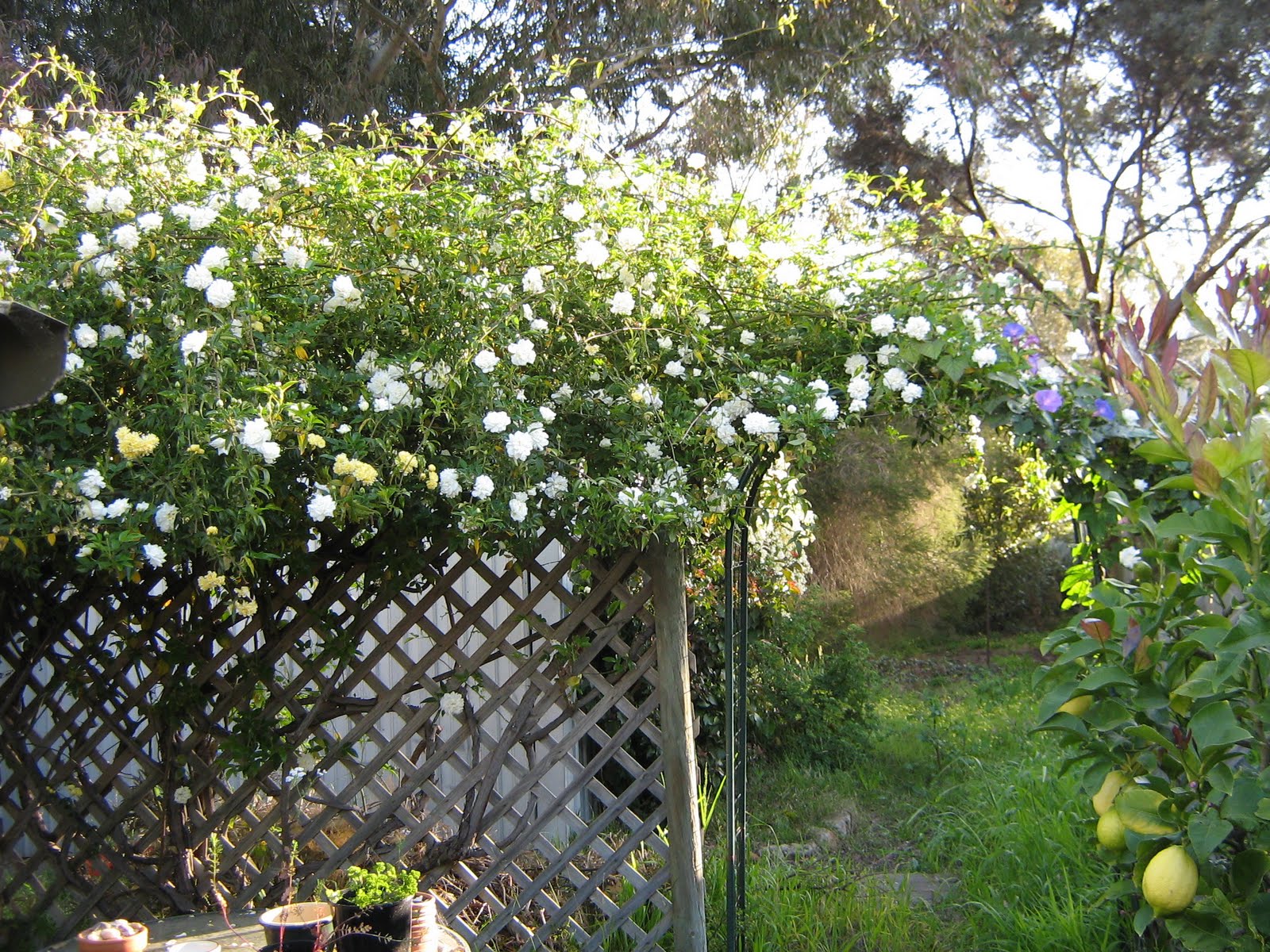
Okay, so a lot in life is currently awry if not completely cactus, but every time I go out into the back yard, the smell of the jasmine all down the side fence wafts over to me in sweet little gusts.


The whole back yard smells like flowers.


And there are other less heady but equally climby and spilly things further down the back.


Given that one of the things getting me down is the treacherous weather, reverting to grey and wet and windy and freezing after that glorious brief breath of spring, it's hard to believe that half an hour ago when I took these photos, the sky looked like this.


Friday, September 9, 2011

Dear Adelaide #2

This time it's not a salutation, it's just a description.


Semaphore Road, 8pm, September 8th 2011.

Thursday, September 8, 2011

Tony Abbott, family man

It's perfectly all right to parade your daughters around to prove you're a straight, clean-living family man. But on the other hand, everyone knows that giving birth is icky secret women's business. Those wussy football clubs whose players and officials don't think twice about stars missing a grand final if their partners are in labour, or indeed Ricky Ponting missing the second Test in Sri Lanka, are just pansies and need to grow a pair.

Whoops, did someone say 'pair'? Not if Daddy Tony has anything to do with it.

Tony Abbott. The go-to guy for all that is spiteful, punitive, hypocritical and mean of spirit.

SPIT.

Dear Adelaide

Dear Adelaide,

You know nobody loves you more than your Auntie Pav. But I tell you what.

It doesn't matter that you have a local ABC radio station: if some of the people on it are insufferable self-identified big frogs in a little puddle, then that's just not quality radio.

It doesn't matter how many brilliantly gifted local artists and musicians you have: they can't sustain their work, much less develop it, if you keep cutting the arts funding, which undermines infrastructures and destabilises long-term planning.

It doesn't matter how many great festivals and events you hold: if you have no faith at all in the homegrown talent, then that sends a really terrible message to anyone who might be thinking about coming here for them. If we think so little of ourselves, why should anyone else be bothered?

And it doesn't matter how many funky little red, white and chrome cafes and sushi bars and baguette joints you cram into the CBD: as long as you start closing them and everything else up around 3.30 pm*, you'll never be more than a small provincial city. Really you won't.

Lots of love,
Pav xxx

PS: as with ethnic jokes and blonde jokes, the only people who are allowed to diss Adelaide are those who live here. Any comment deemed unacceptable will be removed.

*This is not an exaggeration

Wednesday, September 7, 2011

Trusting the girls in the back room

On the grounds that it's never too early to start worrying about something, I have been worrying about a keynote speech that I don't have to give until February. I have to worry about it now, because, come the day, all my worrying capacities may well be used up on the problem of how to get to the venue in 47 degree heat without losing consciousness, but we'll cross that bridge when we come to it.

In the meantime, what to say to an academic conference when you haven't been an academic (not a fulltime one anyway) for thirteen and half years? How to approach this topic? What to do?

But a few weeks ago as I headed south down the unlovely Tapley's Hill Road, en route to the marginally less unlovely West Lakes Mall across the road from AAMI Stadium, registering on autopilot the elderly road-crossers, the non-signalling lane-changers, the speed-limit-excessers, the potential drag racers and the current price of petrol and bananas while thinking about my shopping list and its eccentricities, the solution came to me. It just appeared as if by magic, dropping into consciousness like a ripe fruit. There it was.

After I got home, I sat down at the computer and checked the Doonesbury strip for the day, where I found a link to a rare interview with its author (is that the word for a cartoonist?), the incomparable Garry Trudeau:

There must be many days when the ideas don’t come. What does he do then? Walk in the park? Dose himself with double-espressos? “That pretty much describes every day. I spend a lot of time not coming up with ideas, but assuming you’re temperamentally suited for deadline work, you do learn to trust the boys in the back room.

“I know how to prepare myself, but I have no idea how the actual imagining works. I often abandon an idea as hopeless, only to find weeks later that my brain has mysteriously solved the problem without any apparent guidance from its owner.”

My idea for the keynote speech had most certainly come from the girls in the back room. One minute I was floundering, and the next minute I had a phrase that constituted a whole argument, plus a potential framework for a structure. I'd call it a thesis sentence, except that strictly speaking it's not a sentence.

But in my own work, I trust those backroom girls more for the bigger projects than I do for the weekly deadline. Sometimes -- often -- they are napping, and writing four short fiction reviews a week, which is in fact a highly exacting task if you have any ambition at all to do it well, is something they couldn't always be bothered to stir for. They are the Marys to the mind's Marthas -- the Marthas being the girls in the bar, if you will, cheerfully serving the drinks, cleaning the tables and keeping an eye on the till. Those girls are the years of experience and training, and their job is to say to me 'This is your life's work. If you can't sit down and write a workwomanlike piece as part of the day's tasks after all this time, then you can't do anything at all.'

Saturday, September 3, 2011

Hey STELLA!

Last night in Melbourne's Federation Square, the new Stella Prize for the best book of the year by an Australian woman was launched as part of the Melbourne Writers' Festival. I did something uncharacteristically frivolous and flew over for the party.

The only people in this photo I actually recognise are journalist George Megalogenis, the tall dark dude over to the left, and Scribe publisher Aviva Tuffield, who is the smiling woman with darkish shoulder-length hair tucked behind one ear, at far right.

Chris Gordon, the events manager at Readings bookshop and a fellow member of the Stella Prize steering committee (as is Aviva, above), spoke persuasively of the need for sponsors and donations, and then introduced Australian feminist legend Anne Summers, author of Damned Whores and God's Police, which if memory serves was the first, or certainly one of the first, books in Australia to look at Australian history and culture through the lens of a feminist reading.

Anne officially launched the prize, reading the notes for her speech straight off her iPad, the first (though no doubt not the last) time I'd ever seen anybody do that. One of the most arresting things she said was that things were actually better for women in 1994 and we had apparently gone backwards.

But mostly the party was about the prize: what we've done so far, what we have still to do. The large crowd included most of the steering committee, mostly Melbourne writers and publishers: Chris, Aviva, Monica Dux, Jo Case, Rebecca Starford, and Sophie Cunningham who started it all.

Sophie Cunningham (R) with Pip McGuinness from NewSouth Books, the brains behind their Capital Cities series and therefore publisher of Sophie's book Melbourne and, next month, my book Adelaide.


The other Melbourne committee members include Jenny Niven, the MWF programmer, who I don't think was there (if I were the MWF programmer I'd be home in a coma by now) and Louise Swinn, who wasn't well. Susan Johnson from Brisbane also wasn't well enough to come, though she'd planned to. Kirsten Tranter and I flew down from Sydney and Adelaide respectively. See the Stella website at the above link for more detail on all these people.

L to R: Monica Dux, Rebecca Starford, Jo Case


Others spotted in the crowd included Melbourne publishing legend Hilary McPhee; longtime literary editor of The Age Jason Steger; publishers Philippa McGuinness from NewSouth Books and Michael Heyward from Text; Adam Bandt MP, the Federal Member for Melbourne; and Mark Rubbo, Managing Director of Readings bookshop, who has been a quietly effective supporter of the Stella Prize from the beginning.

Sophie Cunningham, Adam Bandt. The person he is talking to is probably Kirsten Tranter -- I think I recognise the outfit.


It was Kirsten who wondered on Facebook the night before the party which members of the steering committee would be out in Flinders Street drunkenly shouting 'Hey STELLA!' before the night was over. The closest I got to that myself was a quiet bottle of Stella Artois back in my hotel room later that night as I read the grisly new Val McDermid. My days for this sort of thing are a very long way behind me.


Thursday, August 25, 2011

Of course they bloody do

Michelle Grattan's piece in the Age today is not only disingenuous but even perhaps a tad hypocritical, reporting today from well up in the high moral ground that the Federal Labor MPs all have cheat sheets, media questions, for the answering of.

Because as if the very best efforts of Craig Thomson were not enough to bring the party crashing down around his ears and usher in the era of Prime Minister Tony Abbott, who if he falls over will be replaced by Prime Minister Julie Bishop, some unidentified (a) total doofus or (b) rat in the ranks (tick one) has left his or her notes lying around on a chair where, of course, the meeja just happened by and picked them up.

Whether it was done by accident or design, you can only imagine what Julia Gillard is thinking this morning. When you've been forced by circumstance to make a fateful lose-lose decision about leading your party, fought an election, exercised your stunning negotiating skills to form government, kept it all together for over a year despite some truly frightful attempts to oust you, and made a few appalling mistakes all by yourself, who needs a rabid, grubby Opposition, a hostile media, a big smear of misogyny right across the national board (Opposition, media, electorate, one's own party, you name it) when you've got one f*ckwit who can't keep either his credit card or the other thing in his pants, and now another who is too absent-minded, or treacherous*, to avoid leaving this kind of thing lying around?

But here's the thing. Of course they've got a bloody cheat sheet. No sensible person who has anything at all to do with media questions would be without one. Because most, not all but most, journalists in our country in its current incarnation seem to think that journalism is about nagging, needling, asking hostile, mindless gotcha questions (50 extra points if you make someone cry or lose his/her temper) and then putting as sensational a spin as possible on whatever the answer was in order to sell more papers. Even Michelle Grattan, who used to be the gold standard.

Or about taking some perfectly ordinary fact, like, say, that MPs have had media training and have paid attention to the advice they were given, and blowing it up with the rhetorical equivalent of a few acronyms and punctuation marks, as here, where the invisible OMGs and exclamation marks are thick on the ground. Get real, Michelle. If the media were doing a good job of reporting neutrally and truthfully on the facts, just the facts, about the way the country's actually being run, people wouldn't nead cheat sheets to help with the Augean-stables task of resisting being tormented and misrepresented by the ladies and gentlemen of the press. As it is, WTF do you expect?

*I'm going with 'treacherous'. You don't 'inadvertently' leave your notes 'on an Opposition seat in Parliament'.

Wednesday, August 24, 2011

The Don's legacy: more complex than you thought

The lovely Greta Bradman, granddaughter of Sir Donald.

Saturday, August 20, 2011

Dr Max Nicholls, 1927-2011: a good start in life

When people say 'So-And-So had a good start in life,' they usually mean that she or he was born equipped with silver spoon. I can't claim that, though I do remember being very struck by the words of the great South Australian activist, novelist and parliamentary reformer Catherine Helen Spence, on the first page of her autobiography: 'I count myself well-born, for my father and my mother loved each other.'

My sisters and I had that: they loved us too, and we had a country childhood, and there was enough money (though farming is a tough and jumpy-making gig, whatever townies may think).

And as I now know, as of today, I had the good fortune to be delivered by a very distinguished man.

My earliest memory is of gorgeous red and purple rhomboids and lozenges of light, reflected in the polished boards of the hallway, from the stained glass in the front door of the building I was born in. The Curramulka Hospital had been built on land donated by my great-grandmother (I do so love the enlightenment implicit in that sentence); she laid the foundation stone with the silver trowel presented to her by the contractor for the purpose, and then they all went across the road to the Institute for ice cream and a fund-raising fox-trot competition. Oh, it was all go in Curramulka in 1927.

In February of that year, my dad and a man called Edward Maxwell Nicholls were born within eight days of each other, country boys in different country towns. After an eventful education, Max Nicholls arrived in Curramulka with his young wife in 1951, and stayed long enough to escort me into the world two years later at the age of 26 (him not me) before moving on to Mannum later the same year.

Both of my parents always spoke highly and warmly of him. But I knew nothing about his life as a pioneering geneticist in the wake of that early stint as a country GP until today, when my older sister handed me a clipping she'd saved for me: a content-rich obituary by his daughter Christine Nicholls, herself a distinguished scholar with an international reputation. I particularly like these bits.
... he topped the state in mathematics in his Leaving Honours year. Although he wanted to study pure mathematics, his father urged him to follow a vocational pathway so Max accepted a full scholarship at the University of Adelaide where, in 1944, he enrolled in medicine, boarding as a secular student at Wesley Theological College with his brother, Les. At Wesley, Nicholls's relationship with the authorities was uneasy and his stay was punctuated by constant arguments with resident theologues. He also organised a dance - at a time when dancing was frowned upon by hardline Methodists - and came close to being expelled from the college.
*
After graduating in 1949, he was a resident medical officer at the Royal Adelaide Hospital before joining the Royal Darwin Hospital. As a flying doctor in the service's early days, Nicholls visited remote Aboriginal communities and leprosariums and delivered babies. As a 23-year-old, he briefly found himself in charge of the entire Northern Territory Medical Service when his senior medical officer announced, at a day's notice, that he would be taking annual leave interstate.
*
In 1953, the family moved to Mannum on the Murray River ... He attended many serious boating and drowning accidents and regularly visited the large Aboriginal settlement near Swan Reach, where he co-operated with the indigenous midwife to deliver babies.

He did postgraduate study in genetics in Mannum -- picture the scene: postgrad studies by correspondence in a South Australian country town while managing a large general practice and a growing family -- and not long afterwards was offered a university job, where his research made a significant contribution to what we know about genetics. Read the whole thing here.